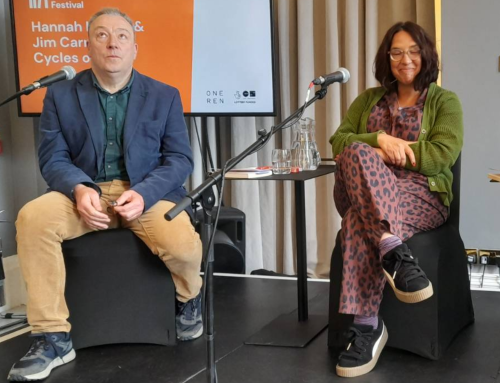
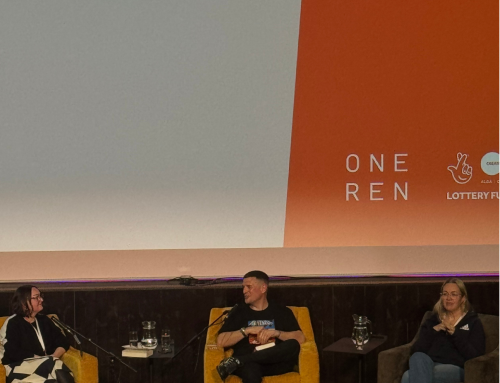
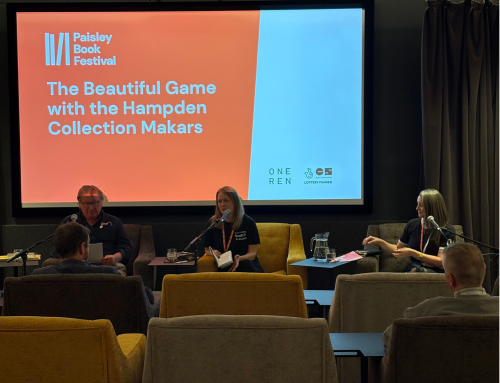
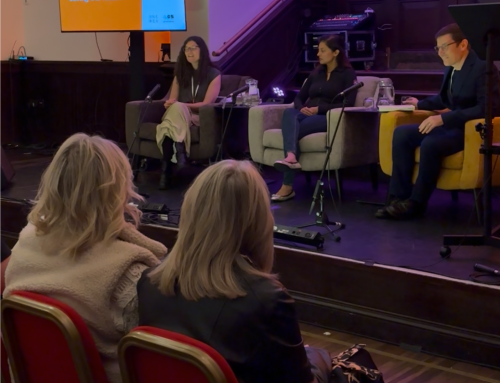
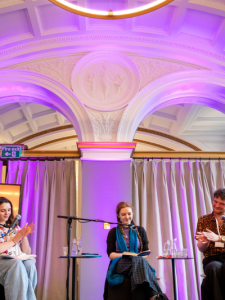
 There are two of Scotland’s foremost contemporary poets sitting on the stage with National Library of Scotland Scots Scriever and award-winning performer Taylor Dyson, and there is absolutely no messing about. Straight to the poetry.
Michael Mullen opens with Harvest. “We’re gaunnae start depressing,” he says, “that way it can only get better… just like yer love life.” Off the bat, the audience are cracking up. The joke lands effortlessly, but the poem itself brings everyone gently back to earth with its gravity. That becomes the rhythm of the evening: humour and hurt, comedy and seriousness, constantly moving into one another.
Straight up next, Len Pennie begins reading her poem Bilingual. It is both effortless and commanding. One line in English, the next in Scots, seamlessly moving between the two, the rhyming couplets holding firm. Despite Len’s humble warning that it might all go wrong, the mastery of the craft is obvious from the outset. The audience hangs on every line.
Taylor Dyson wastes no time getting into the discussion. “So! How does it feel to have your collections out there?”
“Mental!” Len blurts out instantly. “I didnae anticipate being a poet, never mind a published one. I didnae even like poetry at school.” She side-eyes Michael. “Did you?”
Michael laughs. “Maybe I’m more of a swot. I actually did like it.” He pulls a face before answering the question, “It’s both AMAZING and underwhelming at the same time. You think: Hollywood, here I come. But everything’s just the same.”
That dynamic between them, Len’s sharp self-deprecation and Michael’s dry observational humour, gives the whole event an easy chemistry. Both are genuinely funny, but neither feels performative. The humour comes from personality, timing, and a shared understanding of the worlds they come from.
The conversation moves onto titles, publishers, and the Scots language itself. Len explains that Poyums Annaw was originally just a placeholder title. “I said to the publisher, we’ll just call it Poyums Annaw for now,” she says. “I didnae realise authors had that kind of power.”
Michael’s relationship with language becomes immediately tangled up with geography and class. His collection Goonie means different things depending on where you come from. “For me, a goonie’s a dress,” he says, “but for some folk it’s a dressing gown. Depends where yer fae. We could debate it aw day.”
The issue of Scots, and who gets to define it, undergirds much of the discussion. Len jokes about people overthinking the title Poyums, acting out elaborate attempts to intellectualise it. “Poe-Yumms…” she says theatrically, to huge laughter. “It’s phonetic! Some people just don’t get that.”
But beneath the comedy is something more serious. Both poets are acutely aware that writing in Scots remains political, whether people acknowledge it or not.
Michael hits the nail squarely on the head: “You cannae write in Scots without it being a political act, because we were all brought up being told: talk properly.” There is a murmur of recognition around the room. Anyone who grew up in a working-class household in Scotland knows exactly what he means.
Len agrees immediately, but pushes the point further. “It’s important not to relegate Scots to the comedic,” she says. This becomes one of the key moments of the event. She talks about wanting the Scots language to carry the full spectrum of human emotion, not just humour and lightness, but danger, grief, fear, abuse, domestic violence, vulnerability. Scots, linguistically, should be capable of holding seriousness, tenderness and devastation just as much as any other literary language.
It is here that the conversation really finds its emotional core. Taylor seizes on it perfectly by asking why they both started writing poetry in the first place. Len answers first. “My therapist said I needed a hobby.” The laughter is immediate.
But again, underneath the joke is something much deeper. Len explains that she began writing while trying to reclaim herself after an abusive and controlling relationship. Poetry helped her reconnect with herself, but she is careful to distinguish between poetry and therapy. “Poetry is poetry and therapy is therapy,” she says. “Poetry can be self-indulgent and cathartic. Therapy is difficult. Poetry is about connection between minds and souls.”
She turns to Michael.
“Yeah,” he says, without missing a beat. The room collapses once more.
Michael says he had to consciously work on “the sad stuff” because, in his own words, he is “really a happy-go-lucky person.” Again, huge laughter. But that tension, between humour and sadness, runs through both poets’ work and through the entire event itself.
Len talks movingly about wanting her poetry to make her dad laugh and her mum cry. Her father, she explains, is naturally funny; her mother wears her heart on her sleeve. If her poems can emotionally reach both of them, then she knows she has done well. “Humour is what gets you by,” she says. “If ye don’t laugh, ye’ll greet.”
When the discussion moves onto performance, another contrast emerges between them. Michael comes alive talking about spoken poetry and audience interaction. “This,” he says, gesturing around the room, “is where poetry comes alive.” For him, poetry is inherently oral, something that should be stood up and performed.
Len, by contrast, admits that she is deeply introverted beneath the performance persona. She confesses that she never even intended to write a book. Her poems, she explains, originally existed almost like performance sheets, carefully structured rhythmic systems built mathematically around meter and rhyme.
Taylor asks about pre-performance rituals.
“Two pints and not three,” Michael replies instantly. Again, the audience is gone.
Len says she wishes she had a ritual but mostly just tells people how anxious she is. She describes pacing around reading poems aloud to herself in the dark. She needs to hear the words, to say them out loud. If other people are in the house, they occasionally come in worried, particularly if she is trying to work through an angry poem while hunting for a rhyming couplet. “They come in asking, are ye okay?”
By this point it becomes abundantly clear that either of these poets could easily make a parallel career out of stand-up comedy. Their timing is razor sharp. Their storytelling abilities are extraordinary. But what makes the evening work so well is that the humour never undercuts the seriousness of what they are saying. If anything, it sharpens it.
Len Pennie’s trajectory already feels stratospheric in its potential. Michael Mullen, meanwhile, feels like a writer on the edge of something major, with Goonie already attracting huge attention and a novel nearing completion. Together, they gave Paisley Book Festival an event full of wit, politics, vulnerability, language, class, performance and heart. In a festival celebrating Everyday Heroes and Everlasting Icons, they felt like both at once.
Joe Smith