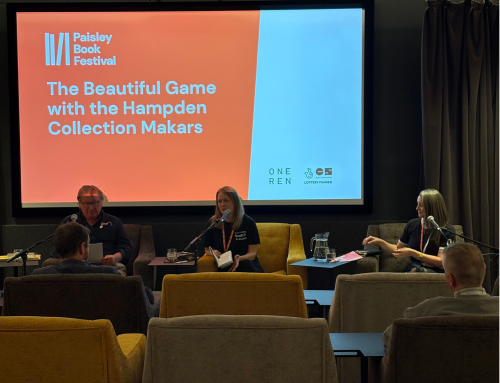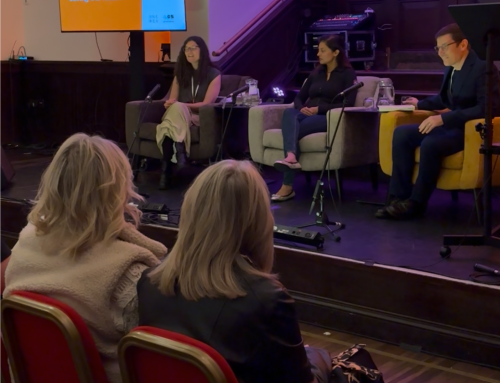
There was something fitting about seeing Jenni Fagan in conversation with Kirstin Innes at the Paisley Book Festival, two writers whose work has always lived close to the nerve-endings of Scottish life, pulling at the threads of class, trauma, imagination and survival. Seven years after the festival’s inaugural outing, Kirstin Innes found herself, once again, onstage interviewing one of Scotland’s most singular literary voices about her new novel, The Delusions. What followed felt less like a conventional book event and more like a dispatch from somewhere between poetry, story-telling, and the end of the world.
“How do we begin?” Kirstin asked. The answer, it turned out, was with the afterlife.
The Delusions, Jenni explained, takes place in a soul processing centre, what she referred to as the largest soul terminus in existence,” where human beings are forced to confront and extract their delusions. It is classic Fagan territory: cosmic and intimate at the same time, mystical but grounded in rage at the world as it exists now.
The inspirations behind the novel emerged quickly. Jenni spoke passionately about what she sees as a sustained attack on both the individual and the collective, a culture increasingly obsessed with spectacle, celebrity and performance while hollowing out the human soul beneath it. In her imagined afterlife there are no celebrities, no PR machines, no branding exercises, no curated identities. Just people. Bare souls. No filters left.
At one point she referenced Donald Trump as an example of how destructive delusion can become when amplified through power and performance. “People like Trump,” she said, “are playing to the wrong crowd.” In the cosmology of The Delusions, earthly fame counts for nothing. Eternity is operating on an entirely different scale.
There was a striking seriousness beneath the humour and theatricality. Jenni described wanting the novel to recreate the “overview effect”, the transformative shift astronauts experience when they look back at Earth from space and suddenly understand both its fragility and connectedness. “If I’m going to die,” she asked herself while writing, “is this the book I’d want to leave behind?”
That existential ambition hangs over the novel. But so too does anger. Environmental collapse threaded through much of the discussion. “What are we doing to the planet?” Jenni asked the audience. “People don’t get held accountable.” The novel’s afterlife becomes, in part, a moral reckoning for a civilisation drunk on extraction, ego and denial. Yet there is also something deeply utopian beating beneath it all: a belief that the soul, stripped of status, money and hierarchy, is the only thing that ultimately carries value.
As ever with Jenni Fagan, the boundaries between imagination, autobiography and myth felt gloriously porous. Asked how she constructed the architecture of her afterlife, she shrugged off the conventions of literary world-building entirely. She had, she said, simply put ‘shelved’ every fictional afterlife she’d ever encountered. The real breakthrough came while she was ill and feverish in New Zealand. “I channelled it,” she said.
The audience sat utterly transfixed as she read from the novel.
And there is plenty more still to come. Jenni revealed she is currently working on The Fall of Frankenstein, involving the exhumation of Mary Shelley, alongside a novella and a sequel to The Panopticon. “It’s a four-novel year this year,” she laughed, “and there will be no novels next year.”
The audience questions pulled the conversation in an even more personal direction.
“Have you had to grapple with delusions of your own?” someone asked.
“Yes,” she replied. “I’ve lived an unusual life and had to face a lot of difficult things. In the afterlife, I will undoubtedly have to have some very difficult and uncomfortable conversations,” she joked.
There was something moving in hearing Jenni reflect on turning fifty this year. She spoke nostalgically about growing up before the digital age. Square televisions, where you had to change channels by pushing clunky buttons. Beneath it sat a clear unease with the algorithmic age: social media, smartphones, and the endless noise that enveloped them. You got the sense that The Delusions is, in part, a rebellion against all of it. A demand for depth and substance in a culture addicted to surface appearances.
Another audience member asked about discomfort. Jenni’s response: “I’m an edge-walker. I’ve lived in discomfort all my life. I chose to go into the belly of discomfort.” That line alone explains a lot about her writing.
Perhaps the most touching moment came when discussion turned to poetry, her “God source”. Poetry, she explained, became her religion when she was young. Not religion in the institutional sense, but as a form of survival. She spoke candidly about suffering panic attacks and profound emotional pain in her early twenties before quietly reciting: “Glut thy sorrow on a morning rose…”
Later, discussing why many of the soul-processing Admins in The Delusions are neurodiverse, Jenni spoke openly about living with OCD. “The wrong kind of OCD, Not the kind people think is quirky or cool.” She also celebrated the language that has evolved over the last two decades allowing us to describe the vast spectrum of human experience and the ways that human’s function.
And finally, inevitably, came the question of Scottishness. Jenni described it not as a nationality but “an attitude of mind.” Scots, especially working-class Scots, are natural storytellers, she argued, chatty and resistant to authority. She invoked James Kelman and Tom Leonard, recalling Kelman’s legendary response to elite criticism after winning the Booker Prize for How Late It Was, How Late: “I don’t need to put my hand up and ask permission to tell a story.”
Kirstin Innes, expertly steering the evening throughout, eventually brought proceedings to a close. The audience wasted no time in heading for the book signing. This was more than a book event, more than literary conversation. For Jenni Fagan’s readers it was a personal revelation from one of the few contemporary authors capable of making the apocalypse sound both terrifying and strangely hopeful.
Joe Smith