 Part of the Festival’s ‘Reclaiming History’s Heroines’ series
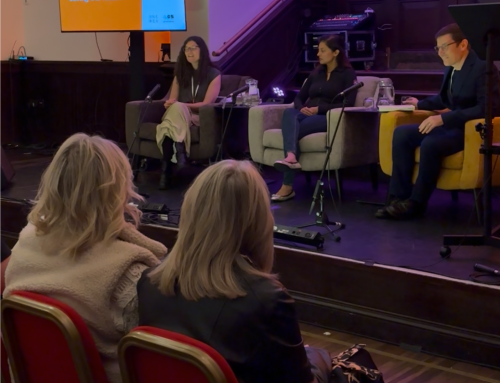
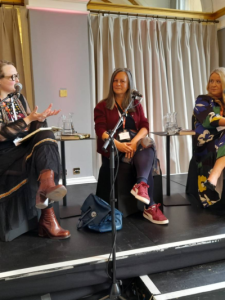
The event’s host, novelist and performer Lucy Ribchester, asked Emma Cowing about the origin story of her novel. Emma Cowing described rummaging through an old family box of photographs when she came across a striking image: an exotic-looking woman dressed in embroidered scarves and a headdress made of coins. The woman was Violet, a distant but direct relation. Emma discovered that Violet was a trapeze artist and bareback horse rider who travelled Scotland raising seven children from a circus caravan.
It was the kind of origin story novelists dream about.
That forgotten photograph would eventually become the inspiration for Show Women, Emma’s new novel about four misfit women who form their own travelling circus in 1910. Hosted by writer and performer Lucy Ribchester, the event brought Emma together with acclaimed historical novelist Sara Sheridan to discuss hidden histories, adventure stories, and the women too often left out of Scotland’s official narrative.
If Emma’s inspiration emerged from family memory, Sara Sheridan’s began somewhere between cocktails and creative improvisation. Describing a “drunken lunch” with her publisher, Sara explained that she had enthusiastically pitched a novel about the chaotic beginnings of Edinburgh Zoo, “the Durrells on speed,” as she described it, involving escaped animals, disasters and, memorably, “asthmatic penguins.” Her publisher, apparently unconvinced, asked if she had anything else.
Spontaneously, Sara began talking about the Scottish Crown Jewels being sealed away following the Union of 1707 before being rediscovered decades later by Sir Walter Scott, a discovery that ultimately earned him his knighthood. Out of that historical curiosity came The Jewel Keepers, a fast-paced treasure hunt through Scottish history.
“You’re not going to like this,” Sara joked to Lucy Ribchester, “but I drew on The Da Vinci Code for this one.” She wanted to write a gripping, page-turning historical adventure that moved at speed, but which also challenged the idea that Scottish history must always be dominated by mud, blood and war.
That became one of the event’s strongest themes. Both authors were interested not simply in recovering forgotten stories, but in recovering forgotten women. Scotland’s public history can often feel overwhelmingly masculine, featuring kings, battles, violence, empire, and political intrigue, But historical fiction offers another way of looking at the past. It allows writers to illuminate the worlds women inhabited with one another: communities, friendships, survival, creativity and endurance.
Emma spoke movingly about the realities facing women in travelling circuses and show communities. Running a circus in the early twentieth century required extraordinary resilience in what was still a deeply male-dominated world. Reaching Balmoral and performing for Queen Victoria, hardly known for being easily impressed, demanded relentless determination. Women often had to bend the rules simply to survive and succeed. Yet while wider society frequently denied women authority or voice, Emma noted that women often found strength and solidarity with one another.
That sense of emotional investment ran throughout the discussion. Emma admitted that she had wanted to write a novel since the age of eight, but journalism made it difficult to return home and continue writing creatively. It was only when she discovered Violet’s story that something shifted.
“I think you have to be emotionally invested in a story to be able to tell it,” she said. “And I was all in on this one.”
The readings from both novels were among the highlights of the session. As Emma read from Show Women, the audience seemed to hold its breath, drawn into the precarious, dazzling world of travelling performers and impossible ambition. Sara revealed that she had read an early copy of Emma’s novel and instantly knew it would be a success. Her own reading from The Jewel Keepers brought a different energy entirely, fast-paced, witty and adventurous, but equally captivated the room.
Although the novels explored very different subjects, they shared surprising thematic connections. Both revolved around hidden objects and concealed histories: jewels walled away, family photographs rediscovered, treasured heirlooms passed between generations. At one point, the audience discovered that both authors were wearing their grandmothers’ rings, a small but telling reminder that objects often carry stories long after official history has forgotten them.
In many ways, that felt like the deeper point of the conversation. Historical fiction does not simply recreate the past; it challenges who gets remembered within it. In a world where statues, monuments and “great men” have traditionally dominated public memory, novels like Show Women and The Jewel Keepers offer another perspective entirely. They remind us that women were never absent from history, only too often absent from the stories history chose to preserve.
For an event framed around Paisley Book Festival’s theme of Everyday Heroes, Everlasting Icons, it was difficult to imagine a more fitting conversation. Not because these books celebrate famous rulers or military victories, but because they recover something far more human: women who endured, who bent the rules, who created communities and carved out lives of adventure and meaning in worlds not designed for them.
Joe Smith