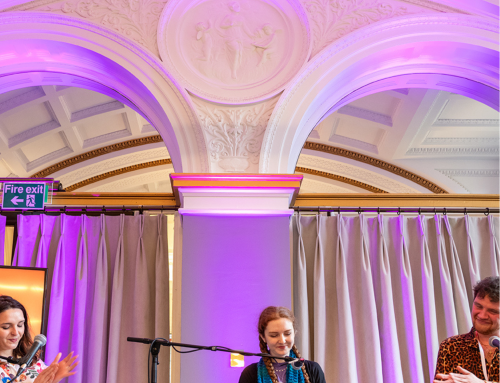
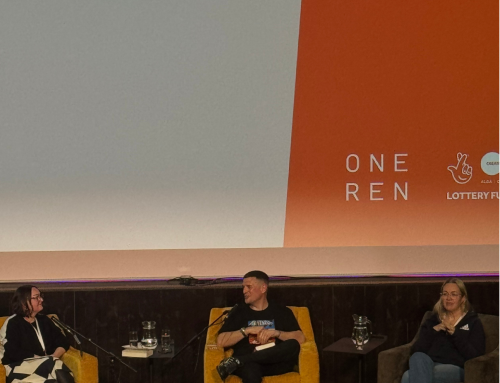
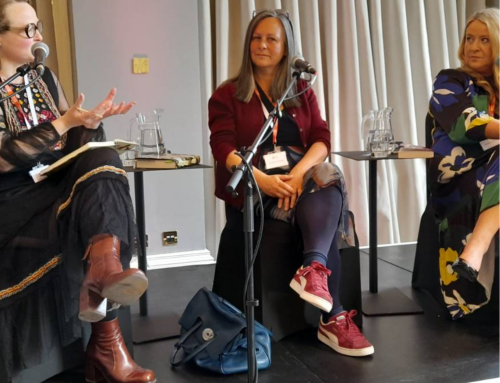
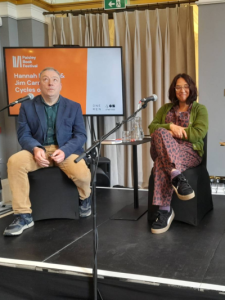
 Cycles of Life saw this year’s theme of Everyday Heroes, Everlasting Icons turn toward poetry’s quieter forms of heroism: endurance, memory, care, grief, survival, and the stubborn act of carrying on. Bringing together former Edinburgh Makar, Hannah Lavery and Glasgow Makar, Jim Carruth, it became less a conventional author event and more a meditation on landscape, time, and the emotional and political weather of modern Scotland.
Jim Carruth read first, offering some context for Knockan, his poetic novella set in Assynt. At its centre are two women: a crofter who farms black Highland cattle, and her archaeologist daughter, who returns for only one week each year – “all they both can tolerate.” It is, frankly, one of the great lines of maternal tension. “A week of vicious closeness looms,” the mother says at one point, and suddenly the emotional climate of the entire book snaps into focus.
Jim Carruth explained that the novella took him nine years to write, partly because he wanted to get the story right, but also because Knockan is operating on a slightly different timescale to the rest of us. Human relationships unfold against hundreds of thousands of years of geology and archaeology: ancient rock formations, extinct species, fossils, seasonal migrations. Assynt itself begins to feel less like a setting than the book’s true protagonist.
Chair Sam Tongue picked up on this immediately, suggesting that the landscape was effectively the novel’s main character. Carruth agreed. The land was never intended as mere backdrop; it shapes the people who inhabit it, pressing itself into memory, identity, and emotion. Sam then floated the idea that “deep time” itself was also a character. Carruth laughed gently at the scale of it all. Geology, he admitted, has a way of making human beings feel small and insignificant.
Sam also highlighted the role of archaeology in the strained mother-daughter relationship. The daughter’s sections, written as sonnets, become acts of excavation themselves: love poems to lost species, vanished lives, female ancestry, and the sacredness of landscape. Eventually, after probing the emotional fault lines of the novella with increasing precision, the event’s host, Sam Tongue theatrically raised his hands and declared: “The interrogation is over.”
Then came Hannah Lavery.
Introducing Everything Everyday, Hannah explained that the collection emerged from a challenge she set herself in 2024: to write one poem every week in response to the world around her. The result is a collection that moves restlessly between the political and the personal, genocide in Gaza, the rise of the far right, Donald Trump, motherhood, exhaustion, tenderness, despair. Her poems are angry and hopeful, delicate and furious, often all at once.
Sam praised the relentless political contemporaneity of the work, and Lavery responded with a statement that felt less like an artistic philosophy than a manifesto: “Everything is political. Everything. Everyday.”
What followed was perhaps the emotional centre of the evening. Hannah Lavery spoke candidly about the paralysis produced by contemporary politics, that feeling that events have become so overwhelming, so constant, that meaningful action feels impossible. How do you parent, live, or simply hold yourself together when the world feels permanently on fire?
Her answer came via James Baldwin: “it is our duty to bear witness.”
If you cannot stop the horror, she suggested, you can at least refuse to look away from it. You can record it. Name it. Leave evidence behind for future generations. “I can bear witness,” she said simply. “I can record it.” The room seemed to collectively exhale.
As the conversation unfolded, Sam Tongue drew connections between the two books. Both are structured around cycles, geological, seasonal, emotional. Both use mythology and the sonnet form to impose shape upon chaos. Lavery noted that the sonnet helped her “hold the emotional weight” of contemporary life, fixing disorder within a disciplined form.
The parallels between the writers became increasingly striking. Carruth spoke of the “quietness” of the rural voice; Lavery expanded that idea into the quietness of marginalised voices more generally, admitting that Scotland no longer felt as safe or tolerant as it once had. The rise of the far right, she said, had constricted daily life for many people she knew. Yet despite the darkness running through the discussion, both writers kept returning to the same conclusion: community matters.
For Lavery especially, community emerged as a form of resistance, perhaps the form of resistance, against an increasingly individualised and demoralised world. If politics isolates, poetry reconnects. If despair fragments, art gathers people back together again.
What made the event resonate so strongly within this year’s festival theme was the way both poets redefined heroism. There were no conquering figures here, no grand speeches or mythic victories. Instead, their work focused on ordinary acts of endurance: grieving, parenting, protesting, surviving, tending to land, tending to memory, tending to one another.
In both Everything Everyday and Knockan, the Scottish landscape becomes something alive, not scenery, but presence. A force that shapes relationships, absorbs history, and carries emotional resilience through time. Together, the books suggested that everyday life itself, with all its fragility and persistence, might be the place where real courage lives.
Joe Smith