 What do football and poetry have in common?
According to the writers gathered for this joyful Paisley Book Festival event, absolutely everything. Bringing together Julie McNeill, Donna Matthew and Hugh McMillan, the session celebrated football not simply as a sport, but as memory, identity, community and working-class culture.
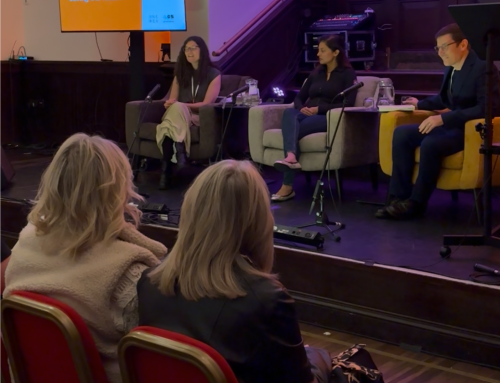
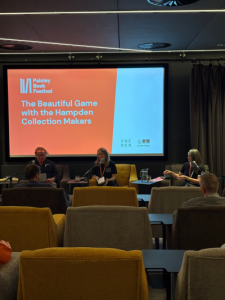
Hosted by Donna Matthew, the event explored how poetry can capture everything from muddy grassroots pitches and cup-final glory to family rituals, women’s football history and the strange poetry of football crowds themselves.
Julie McNeill, Gaffer of the Hampden Collection and Poet in Residence at St Mirren F.C., explained that she never intended to become a football poet. It happened accidentally, through writing about her children, both dedicated young footballers. Her son, now 16, is a committed St Mirren supporter, while her daughter follows the Scotland women’s national football team, inspired by their remarkable journey to World Cup qualification.
One of Julie’s proudest moments came when her poem We Are Scottish Football appeared on Sportscene.
The poem set the tone perfectly: funny, emotional and unmistakably Scottish.
Julie revealed that she often writes “with her back to the pitch”, less interested in tactics than the humanity unfolding around the game. To illustrate the point, she shared a hilarious story from the Euros: two women arriving well after kick-off, prosecco in hand, spending most of the match Facetiming pals back in Coatbridge. The resulting poem was both gallus and oddly moving, a reminder that football is as much about people as the action on the park.
The conversation also touched on Julie’s collaborative work exploring the hidden history of women’s football in Scotland, developed alongside academics Fiona Skillen and Karen Fraser.
One standout story involved singer Eddi Reader discovering that her grandmother had secretly been a highly accomplished women’s footballer at a time when women were effectively excluded from the game.
That history led naturally to discussion of the legendary Rose Reilly, still Scotland’s most decorated footballer and the only Scot to captain a World Cup-winning side after women were barred from playing football in Scotland. Julie’s poem Kick About paid tribute to Reilly’s extraordinary story and to the generations of women written out of football history.
(If this has sparked your interest in Rose’s amazing career, join us at Spectacular Scottish Women on Saturday 16th)
Julie then turned her attention to Hugh McMillan, Makar for the Scotland men’s national football team. Asked about football heroes, Hugh avoided famous names entirely. Instead, he spoke passionately about ordinary people: volunteers, organisers and supporters whose unseen labour keeps football alive.
One particularly moving story centred on writer Robert Graves and the aftermath of the First World War. Traumatised veterans, unable to sleep, wandered the streets of London through the night. Out of this collective trauma came football clubs, social bonds and new communities. Football, Hugh suggested, became a form of survival. This idea, football as collective belonging, ran through the entire session.
Hugh acknowledged that poetry and football are often seen as an unlikely pairing, but argued that poetry has wrongly acquired an elitist reputation. The aim, he said, is to reclaim it as a working-class form of expression. Football is the people’s game. Why shouldn’t it have its own poetry?
Donna Matthew’s contribution brought the conversation firmly back to grassroots football in Paisley itself. A familiar face at the festival, being a key performer at the last 5 festivals, and leading light of Paisley’s poetry scene, Donna reflected on her own journey into performance poetry and the central role football plays in community life.
Her son plays for Glenbrae Colts, and she spoke passionately about the army of volunteers behind youth football in Scotland. Her poem about her son’s former team, Gennifer Thistle, celebrated not just one local side, but the thousands of volunteers who make grassroots football possible week after week.
Another poem, Keeping the Faith, revisited the glory days of 1987, when St Mirren F.C. lifted the Scottish Cup, a moment still etched deeply into Paisley’s collective memory.
Donna also spoke powerfully about the continuing fight for better facilities and opportunities for girls in football, drawing inspiration once again from Rose Reilly and the women who challenged football’s barriers long before the game welcomed them.
By the end of the session, one thing was clear: football poetry is not really about football alone. It is about fathers and daughters. Volunteers and supporters. Working-class communities. Shared rituals. Memory. Humour. Survival. Hope. In other words, it is about life itself, occasionally with a pie and Bovril in hand.
Joe Smith