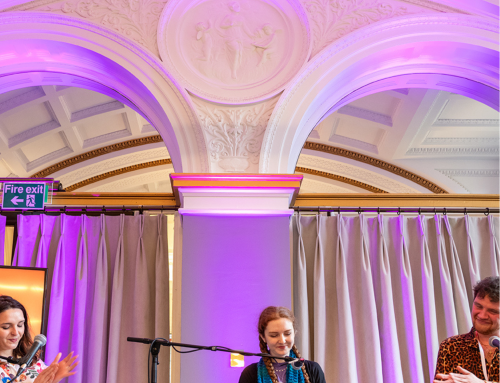
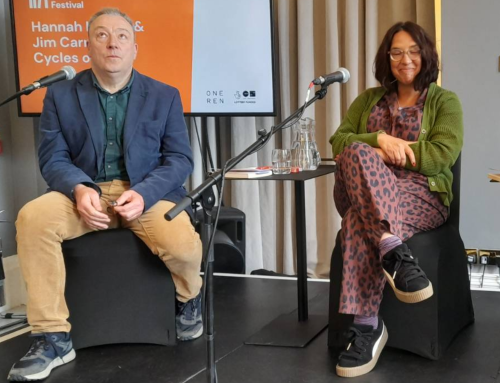
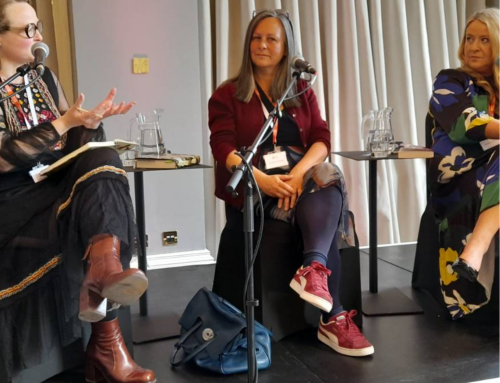
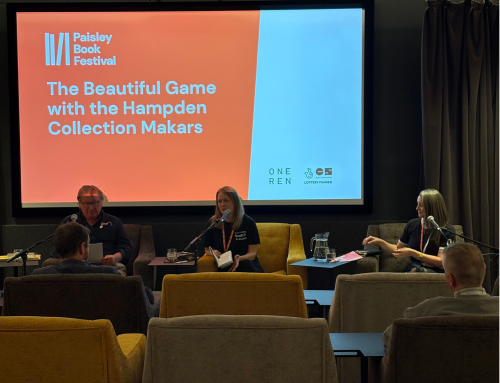
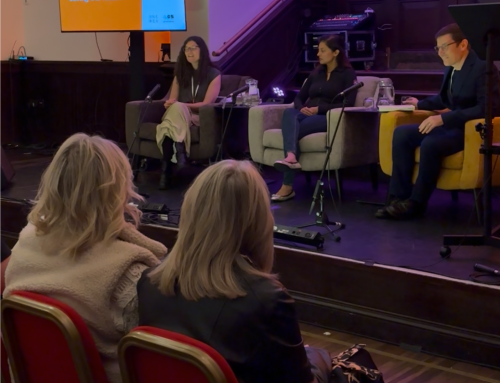
 The room is already buzzing before Graeme Armstrong and Lorna Callery-Sithole even step onto the stage. This is clearly one of the festival’s most anticipated events; the audience leans forward in collective expectation, eager for stories, laughter and the unmistakable energy that follows Graeme wherever he goes.
The applause arrives in waves as the pair take their seats, and Lorna immediately taps into the spirit of the festival’s theme. Turbo, she says, is exactly the kind of character Everyday Heroes, Everlasting Icons was made for: flawed, funny, ordinary, and unforgettable.
Graeme barely lets the applause settle before throwing a question out into the packed hall: “What did we do before gangs?” The answer, he tells us, was the Time Capsule ice rink, neon lights, pounding 90s dance music and an enigmatic DJ booth glowing like a spaceship in his hometown of Coatbridge. “I could remember the tunes,” he says, “but I couldnae remember what the DJ looked like.” From that half-memory came Raveheart, a riotous, funny and unexpectedly political novel centred around Turbo, a past-his-prime Coatbridge DJ navigating a society that seems increasingly determined to crush the joy out of existence.
Alongside Graeme is the event’s host; award-winning, working-class, multi-disciplinary poet, visual artist, and Slam Champion from Pollok, Lorna Callery-Sithole, who brings warmth, humour and razor-sharp timing to the conversation. Together, the pair feel less like interviewer and author and more like two old pals swapping stories in a pub.
The laughs arrive early. Graeme explains that the character, DJ Turbo, was named after a real local legend who earned his nickname because he could deliver “anything” to your door within fifteen minutes. The room erupts. Things get even funnier when Graeme recalls attending a local authority convention before publication and discovering that one now high-ranking professional was once upon a time the real DJ in the Time Capsule booth. “I’ve written a book about you,” Graeme told him. More chaos. More laughter.
But beneath the comedy sits something more serious.
Graeme shifts tone as he talks about the 1994 Criminal Justice Act banning gatherings featuring music characterised by “repetitive beats”, one of the most surreal moments of state overreach in modern British politics. For him, rave culture represented something far bigger than nostalgia: freedom, inclusivity, community and temporary escape from class reality.
That tension between hilarity and political anger gives the event its charge. There is a real electricity flowing between Graeme Armstrong and Lorna Callery-Sithole, an easy chemistry that pulses outward through the audience like a live circuit connecting stories, nostalgia, tunes and collective euphoria.
And the audience are not passive observers. Being a regular at the Paisley Book Festival, Graeme’s fans arrive already speaking the language of his books: laughing at the references, nodding along to the mention of raves, tunes and legendary nights that seemed to last forever. There is affection in the room, but also recognition. For many, these are not simply novels, they are mirrors held up to working-class Scottish life in all its humour, pain, chaos and warmth.
Lorna cleverly steers the discussion between comedy and critique, drawing out the genesis of Graeme’s political awareness and anger. Graeme notes that when he began writing the novel in 2015, people laughed at some of its darker predictions. “My publishers call me Nostradamus,” he jokes, before reflecting grimly on how symbols such as the Scottish Saltire, once associated with pride and belonging, can mutate into symbols of exclusion and hate.
The discussion about language is equally fascinating. Graeme reveals he received at least 300 publisher rejections, many objecting to his dense Scots vernacular. Even his own agent eventually suggested toning it down. Thankfully Graeme refused. Ironically, when Picador finally accepted The Young Team, the language itself became one of the book’s greatest strengths.
“It reads like a play,” Lorna suggests at one point, probably the perfect description. “How does that work for the audio book?” Graeme explains the audiobook was recorded like a radio play, with local actors performing different roles to preserve the rhythm, humour and musicality of the dialogue.
And the music matters. Deeply.
Graeme speaks about rave tracks almost like living beings, evolving through remixes, revivals and cultural memory while he was still writing the novel. “I was editing the track lists days before publication, that’s how much the music is alive”, he told us. Lorna asked if he listened to the music as he was writing the book. “One thousand percent”, he said. “There’s not a tune in this book that I don’t like!”
One of the evening’s strongest moments comes when Lorna bluntly addresses the elephant in the room – drugs. How does Graeme reconcile writing so vividly about rave culture while also working with young people to educate on substance misuse? Graeme answers carefully and honestly. Sober and drug-free for years himself, he rejects the simplistic moralising around glamorising harm. If art sanitises reality, he argues, it stops being truthful. “If I wrote about violence through the eyes of a 14-year-old boy, and it’s not glamorous, then it’s not real.” He points out the fact that vast majority of drug deaths in Scotland are down to opioids, rather than recreational drugs, but does acknowledge that there are still 15 MDMA related deaths each year.
Throughout it all, Lorna Callery-Sithole keeps the atmosphere buoyant and grounded. Her humour and local insight stop the conversation ever becoming overly earnest, while still allowing space for the bigger questions sitting underneath the novel: who gets to belong, who is excluded, and how ordinary people resist systems that gradually erode freedom and solidarity.
Lorna opens the session up to questions and the audience scramble for Graeme’s ear. They ask about nostalgia, musical snobbery and trauma. The last question – “is Raveheart easier to talk about than The Young Team?” – is met with a nod of total agreement. “100%” he said.
The evening closes on a thoughtful note as Graeme reflects on what he calls “trauma bombing”, the strange phenomenon whereby people feel compelled to unload their most painful stories onto him because he wrote so powerfully about violence, addiction and survival in The Young Team.
Raveheart, he explains, comes from a very different emotional register. Where The Young Team carried the weight of trauma and philosophy, Raveheart allows itself joy, absurdity and laughter. Turbo may be politically sharp, emotionally intelligent and deeply observant of the world around him, but, as Graeme grins, “he’s as daft as a brush.”
It is perhaps that daftness, that refusal to surrender humour, music and human connection in increasingly joyless times, that makes Turbo such a compelling creation. Beneath the rave nostalgia and comic patter lies something quietly radical: a belief that community still matters, that ordinary people still matter, and that dancing in the dark with strangers can itself become a small act of resistance.
Joe Smith